
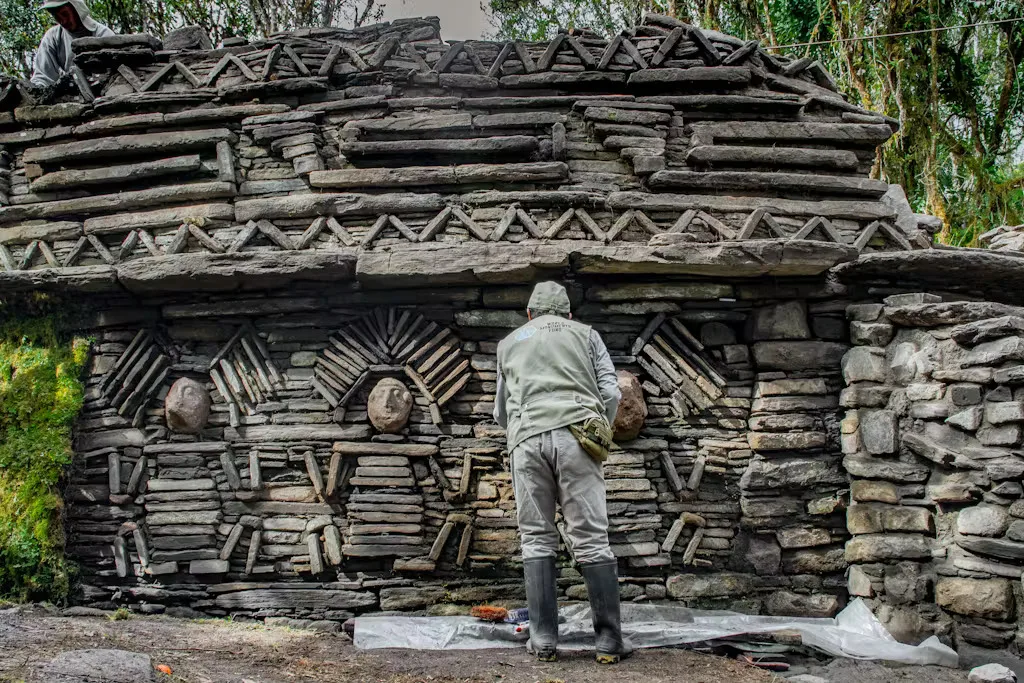
A groundbreaking archaeological discovery was made at Gran Pajatén, a pre-Hispanic site within the Río Abiseo National Park in Peru’s San Martín region. The World Monuments Fund (WMF) announced that more than 100 previously undocumented structures linked to the ancient Chachapoya civilisation have been identified, shedding new light on one of South America’s most enigmatic cultures.
The site is part of a UNESCO Mixed World Heritage area and has only 26 known structures since its initial exploration in the 1980s. The new findings dramatically expand our understanding of the Chachapoya’s architectural sophistication and regional influence. The discovery follows a major research initiative undertaken by WMF Peru between 2022 and 2024, involving extensive fieldwork, conservation measures, and cutting-edge remote sensing.
The Chachapoya people, known as the “cloud forest civilisation”, thrived between the 7th and 16th centuries in the northeastern Andes. Renowned for their circular buildings, intricate friezes, and cliffside tombs, they developed impressive urban and ceremonial centres in high-altitude terrain ranging from 2,000 to 3,000 metres above sea level. Though fiercely resistant to Inca domination, they were eventually absorbed into the empire shortly before the Spanish conquest.
Gran Pajatén, first brought to light in the 1960s, features ceremonial buildings adorned with stone mosaics and reliefs depicting human forms, all overlooking the verdant cloud forest. Much of the site had remained obscured by dense vegetation, with its broader significance largely speculative until now.
The latest discoveries were made possible through a combination of advanced technologies, including aerial and ground-based LiDAR scanning, photogrammetry, and topographic modelling. These methods allowed archaeologists to digitally see beneath the forest canopy and generate the most comprehensive map of the site to date, without physically disturbing the environment.
“This discovery significantly broadens our comprehension of Gran Pajatén and suggests it was part of a much larger, interconnected network of settlements,” said Juan Pablo de la Puente Brunke, Executive Director of WMF Peru.
Bénédicte de Montlaur, President and CEO of WMF, added, “What makes this truly remarkable is not just the scale of the findings, but the way in which we uncovered them. Technology enabled us to document and understand this fragile site while preserving it for future generations.”
The research also uncovered a network of pre-Hispanic roads linking Gran Pajatén to other key sites, including La Playa, Papayas, and Los Pinchudos, reinforcing theories that the area formed part of a complex, hierarchical territory. Soil analysis indicates the site may have been in use as early as the 14th century, if not earlier.
In addition to mapping and surveying, conservation efforts were carried out at one of Gran Pajatén’s most important structures. The team performed controlled vegetation removal, digital documentation, and physical stabilisation, including the reinforcement of stone elements using a specially formulated clay mix that preserved the integrity of the original architecture.
“This intervention is a pioneering model for conservation in similarly sensitive environments,” said Dr Ricardo Morales Gamarra, who led the preservation efforts.
To mark the significance of this discovery, a public exhibition is currently on view at the Museo de Arte de Lima (MALI) until 18 June. The display offers insight into Chachapoya heritage and showcases WMF’s latest documentation, allowing visitors a rare glimpse into this otherwise inaccessible site.