
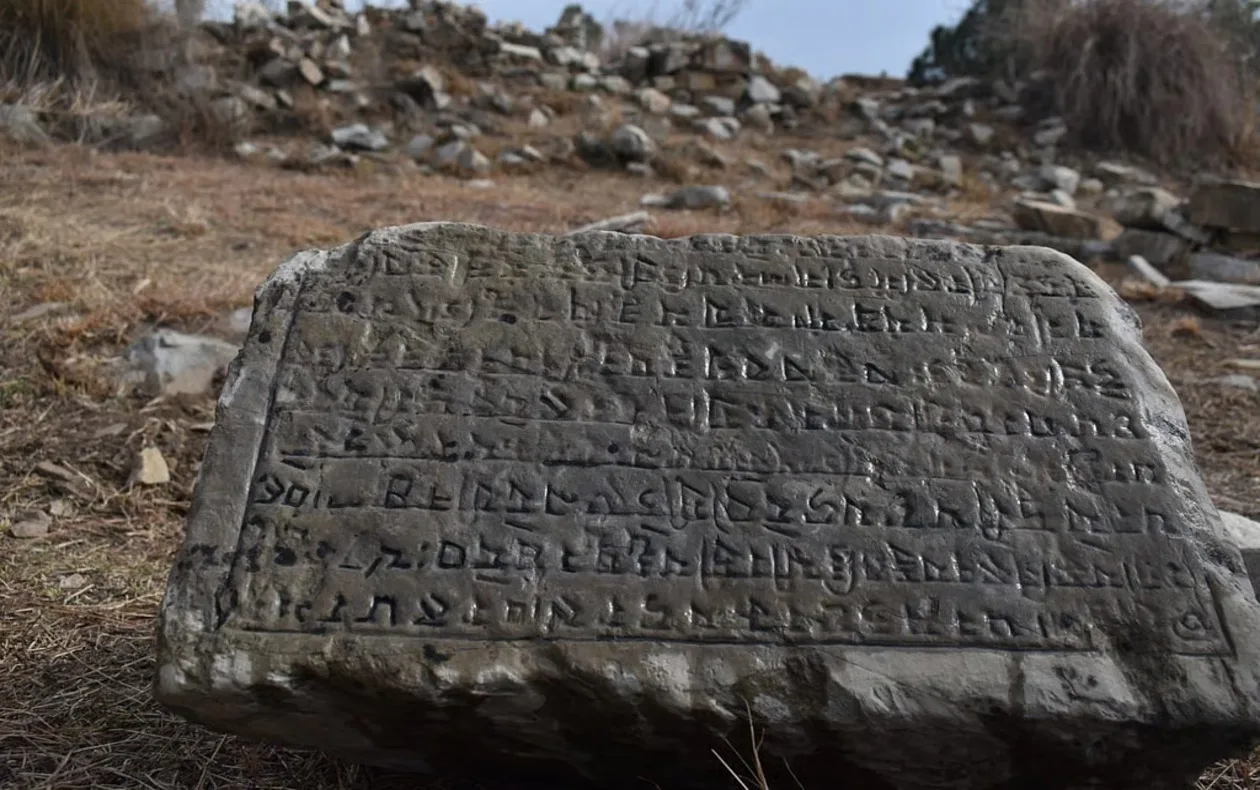
A notable archaeological find in the Kotli district, located near the Rajouri-Mendhar belt of Pakistan-administered Jammu and Kashmir (PaJK), has brought to light a potential historical connection between the region and the Korean Peninsula.
This significant revelation made by a local archaeologist is generating considerable interest among historians and cultural scholars and is being viewed as a promising development for heritage tourism in the area.
Dr Rukhsana Khan, Associate Professor at the University of Azad Jammu and Kashmir and Director of the university’s Sharda Centre of Learning, reported the discovery of a stone inscription in the rugged terrain of southern Kotli. The inscription, according to her preliminary assessment, features a combination of Korean characters and the Proto-Sharda script.
“Early analysis suggests that this inscription may indicate a historical link between the Kotli region and ancient Korea,” said Dr Khan. She noted that such inscriptions were typically utilised for religious, administrative, or land demarcation purposes in antiquity.
Dr Khan contextualised the find within the broader historical backdrop of Buddhism’s dissemination from Kashmir to East Asia, including China and Korea, via the ancient Silk Road. This expansive network facilitated not only trade but also the exchange of religious and cultural practices across vast regions.
The Kotli site is positioned strategically at the intersection of the Kashmir Valley and the Jammu region and is believed to have functioned as a key cultural and spiritual conduit in earlier civilisations. Archaeological excavations at the site have unearthed several other important artefacts, including prehistoric rock shelters, cave dwellings hewn into stone, large limestone boulders bearing faint human likenesses, ancient water reservoirs, burial mounds, and fragments of pottery.
These findings collectively suggest a continuous human presence and activity in the region spanning from the 4th millennium BCE to the 18th century CE, highlighting its long-standing cultural significance.
Dr Khan has described the discovery of the bilingual inscription as the most remarkable aspect of the excavation. She emphasised the need for collaborative research efforts, particularly involving Korean academics, to undertake a thorough analysis of the artefacts and to reconstruct historical ties between the two regions.
The Sharda Centre of Learning is now coordinating with other academic institutions across Pakistan to pursue detailed investigations of the findings. Dr Khan expressed optimism that these discoveries could greatly enrich the historical narrative of Kashmir and position the area as a valuable destination for cultural tourism and archaeological exploration.